“Slender diagonals of light leaned in through the front window, so that all the flecks of dust showed off like ballerinas…The sun, unseen for days, crept furtive on worn spines or the gilt names of vanished authors, burnishing the typefaces and titles to a coppered mausoleum of unwanted sentences.”
The abundance of humor and absurdist shenanigans in The Great When assures that the book will never be taken for literary fiction. But the language is rich, well-crafted, and the eye on human nature is unyielding. At times the prose is so dense with description that I wondered if he ran out of breath typing it.
What I found puzzling is Alan’s patchwork sense of novel construction. He begins thusly: a scene with two aging wizards discussing the fall of magic circa WW2, then skips to a scene of poet David Gascoyne walking through a surreal London scene, then to an African oracle of the racetrack hawking his tips, then to a dreadful (Alan loves the word “dreadful”) sentient membrane hanging on a ceiling, and ending with a scene of a young boy during a WWII air raid. All of these are styled as parts of a piece of music (woodwind, brass, etc.), when music plays no overt part in the novel that follows. So we start with eighteen pages of dense description, five scenes, and absolutely no idea what the plot of this book is about or who our main characters are. Because, confidentially, three of the characters do not play a direct role in the novel, and two are only passing characters. Happily, one does turn out to be Dennis Knuckleyard, the main character.
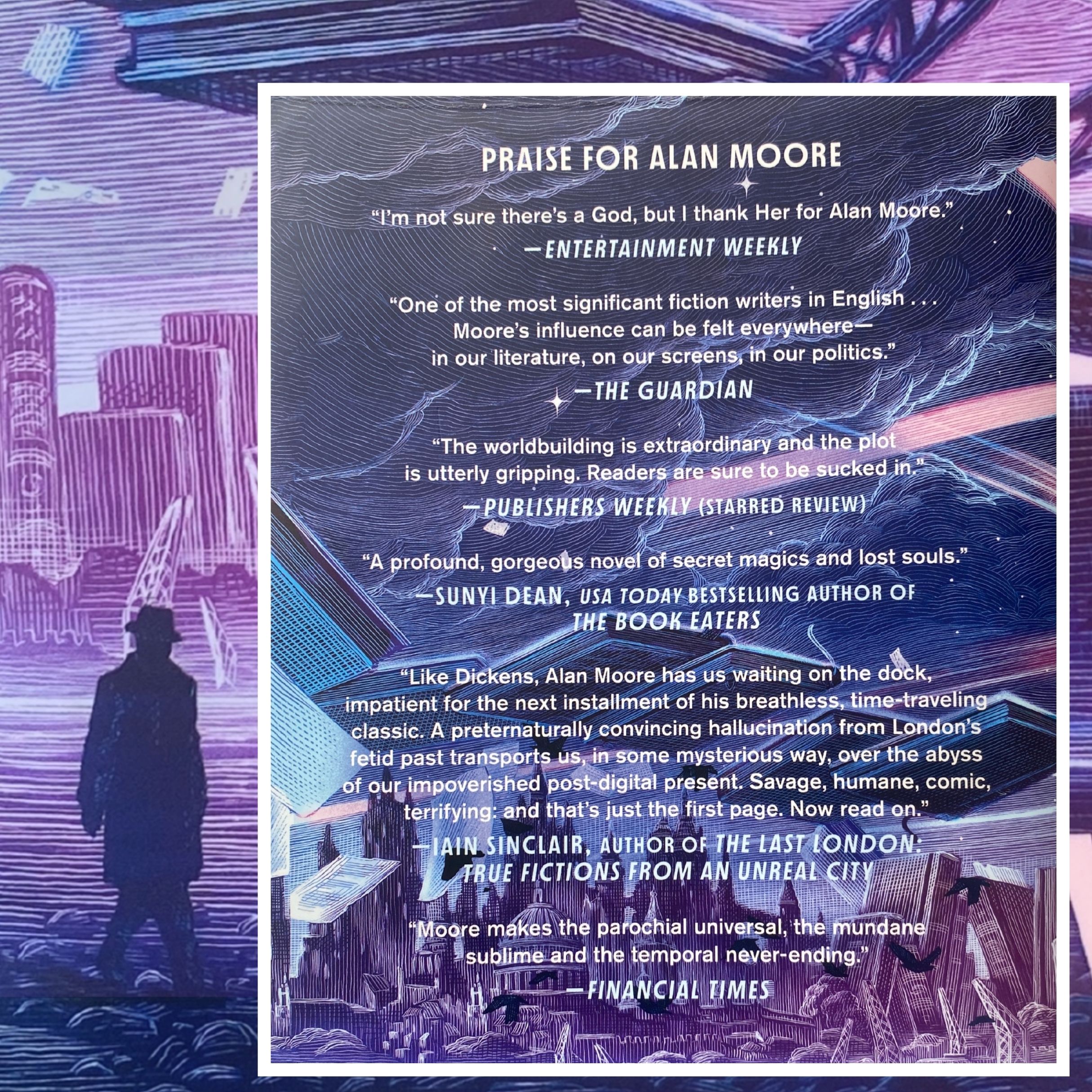
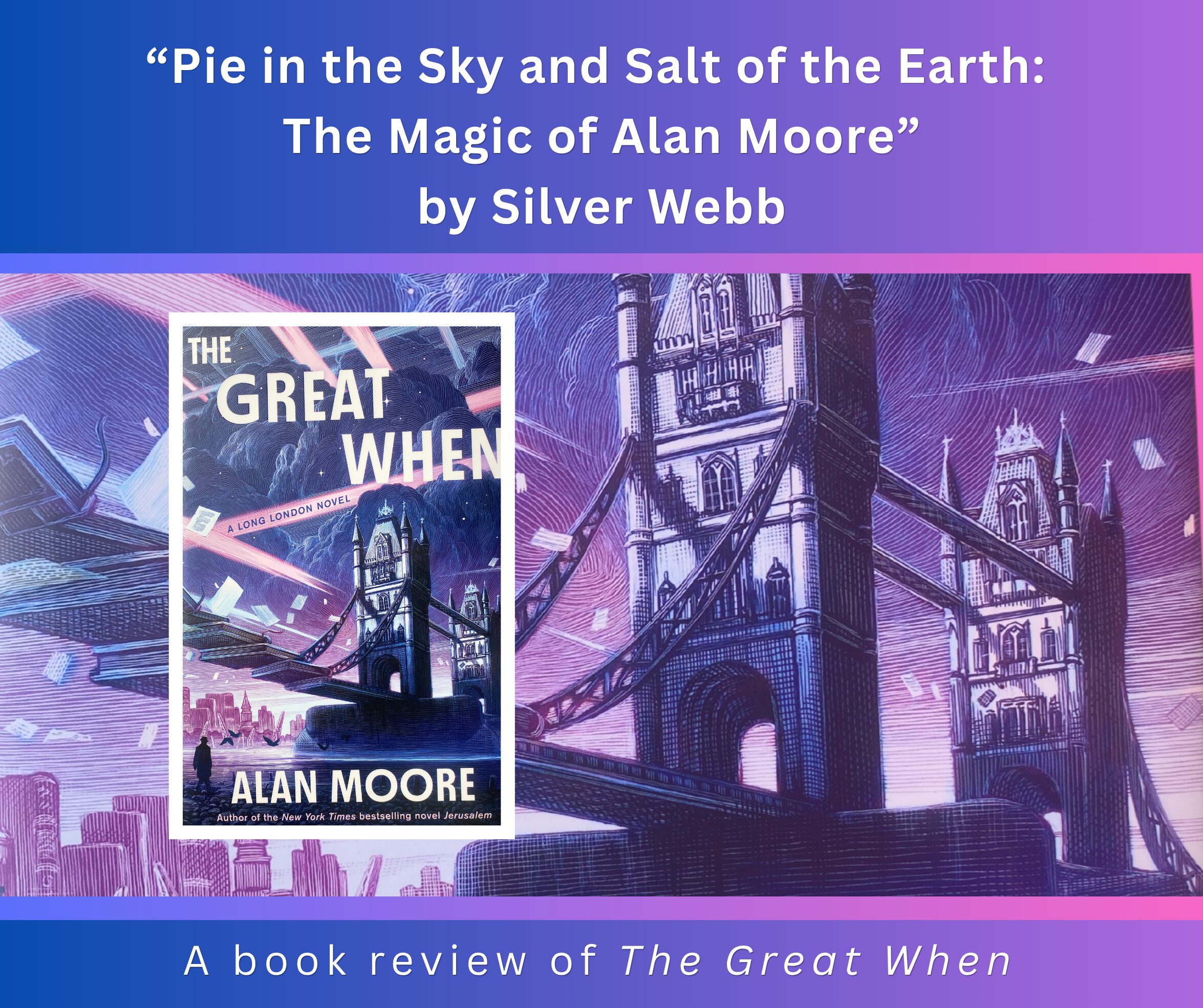
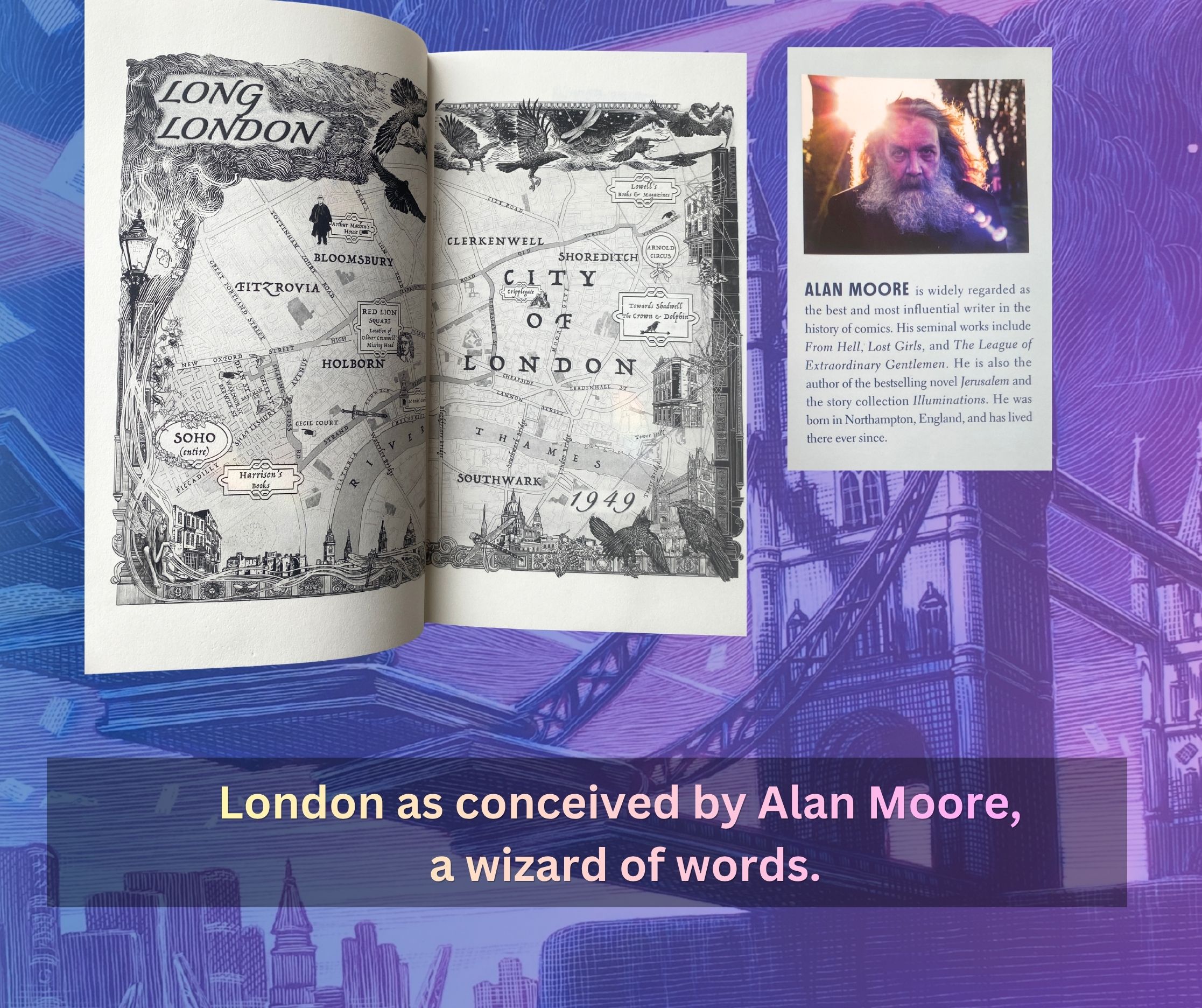
I actually put the book down after that first chapter and didn’t pick it up again for six months. It was a cacophony of many balls thrown up in the air at once, with only some landing later in the novel. But the book was saved by its looks. The Great When in hardcover has the talented Nico Delort’s cover art and gorgeous internal illustrations by Nicolette Caven and is beautifully laid out inside. I couldn’t bear to donate it, and eventually picked it up again, relieved to find that after that first chapter, it settles into two-hundred pages of narrative that follow one character: The hapless, impoverished Dennis Knucklyard eking out an existence as an unpaid clerk and lodger at a second-hand bookstore in the post-war rubble of London. The writing, while dense, flows quickly, and has the interesting touch of switching to italics for scenes of psychedelic tomfoolery in a parallel London.
We follow as Dennis is thrown into a quest to return a book to the other London, narrowly avoid all kind of mangling and evisceration at the hands of both London thugs and the Other London’s surreal inhabitants.
And then? At page 200, Alan wraps up all the major plot points that have been presented so far. Done. The book should end, we think. Instead, he tacks on 100 more pages of a plot that while hinted at in the first two-thirds of the book, is in no way something that the reader expects or needs as anything other than character development for Dennis that may (or may not) pay off in Book 2. And Alan ends with a baffling epilogue with an unspecified character contemplating mortality and modern London. Whether these are just Alan’s thoughts on death and London, or a character in the book’s line of thinking, we do not know. It only seems to connect to the start of the book in that it mentions a cat. It had me wondering if nobody at Bloomsbury Press had the brass to put the editing pen to Moore’s unapologetic anarchism run off the rails. So. There’s that. You have to love language to sit through some of the obscure bits. And I did. And I loved it.
I will also say that some of what he’s playing with comes close to China Miéville’s The Last Days of New Paris, which is set in WW2 with surreal art come to life. Miéville also wrote a book called The Lun Dun several years ago that, while middle-grade fiction, is about a magical alternate version of London. I’m not saying Alan mainlined Miéville and spit out The Great When. But he certainly must be aware of those books, as well as Ben Aaronovitch’s The Rivers of London Series, V.E. Schwab’s A Darker Shade of Magic, and Neil Gaiman’s Neverwhere, all of which take a parallel or hidden magical London to be their premise. Alan is playing with an idea already well established in our literary imaginations rather than innovating a new one.
Aside from word-smithing, Alan shines at describing the city itself, positioning the story within a historical moment, sketching familiar characters, and giving dialogue with the many flavors of London dialects. I clicked into the world and believed in the characters, though they ranged from human to abstract sentient archetypes.
The women in The Great When stand out, if for no other reason than they offer no end of confoundment for our hero Dennis. The beautiful street walker Grace is drawn into Dennis’s misadventure, and the deliriously awful Coffin Ada, Dennis’s landlady and boss, sets the entire plot in motion, having instructed Dennis to buy the book that causes the crisis. His limerent fascination with Grace, who despite Dennis’s fantasies, is not looking to be rescued, ends on a realistic note. And the same is true for Coffin Ada, who it seems Dennis will forever be indentured to. In a neat bit of math magic at the end, Dennis finds out that Grace is much younger than he thought (15), and so is Coffin Ada (51). With this reversal of numbers, it seems Alan intimates that Grace will become something like Coffin Ada eventually, that none of them will ever escape the oppressive poverty that has overtaken a London decimated by war. Having gone through a crash course of the magical life of the other London, Dennis ends resigned to marginal survivorship and melancholy. As character arcs go, it’s kind of a downer. You’d think for a book based on magical premise that author might go for some kind of silver lining. But I suppose with a new book coming out in this series, there is the possibility that young Dennis may yet make something of himself. I will certainly be reading to find out. Pie in the sky and salt of the earth, fantastical and grimly mundane; Alan Moore really is a wizard of words, and I recommend the book to anyone who likes intelligent writing and wildly imaginative worlds.