Pie in the Sky and Salt of the Earth: The Magic of Alan Moore

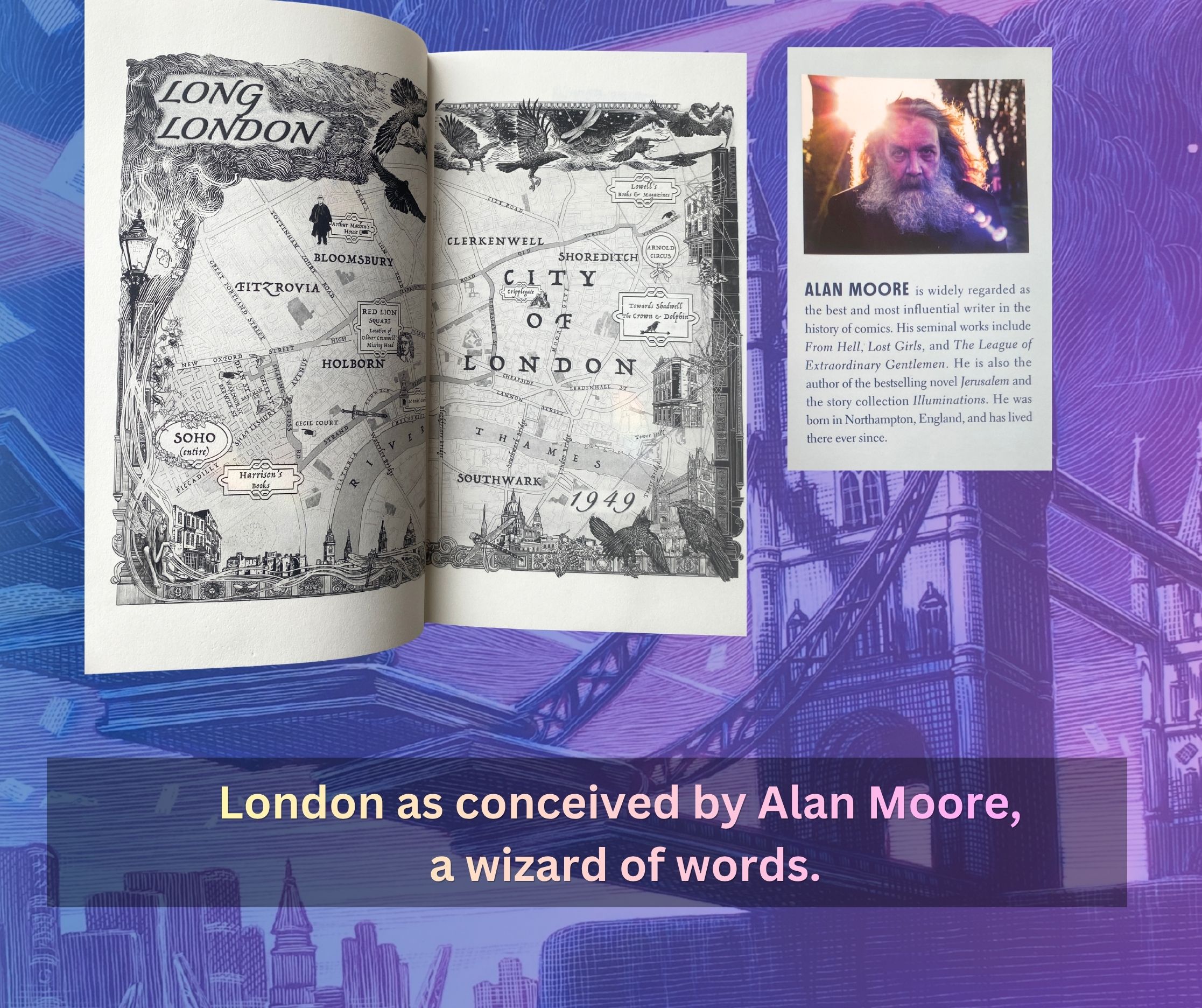
“Slender diagonals of light leaned in through the front window, so that all the flecks of dust showed off like ballerinas…The sun, unseen for days, crept furtive on worn spines or the gilt names of vanished authors, burnishing the typefaces and titles to a coppered mausoleum of unwanted sentences.”
The abundance of humor and absurdist shenanigans in The Great When assures that the book will never be taken for literary fiction. But the language is rich, well-crafted, and the eye on human nature is unyielding. At times the prose is so dense with description that I wondered if he ran out of breath typing it.
What I found puzzling is Alan’s patchwork sense of novel construction. He begins thusly: a scene with two aging wizards discussing the fall of magic circa WW2, then skips to a scene of poet David Gascoyne walking through a surreal London scene, then to an African oracle of the racetrack hawking his tips, then to a dreadful (Alan loves the word “dreadful”) sentient membrane hanging on a ceiling, and ending with a scene of a young boy during a WWII air raid. All of these are styled as parts of a piece of music (woodwind, brass, etc.), when music plays no overt part in the novel that follows. So we start with eighteen pages of dense description, five scenes, and absolutely no idea what the plot of this book is about or who our main characters are. Because, confidentially, three of the characters do not play a direct role in the novel, and two are only passing characters. Happily, one does turn out to be Dennis Knuckleyard, the main character.
I actually put the book down after that first chapter and didn’t pick it up again for six months. It was a cacophony of many balls thrown up in the air at once, with only some landing later in the novel. But the book was saved by its looks. The Great When in hardcover has the talented Nico Delort’s cover art and gorgeous internal illustrations by Nicolette Caven and is beautifully laid out inside. I couldn’t bear to donate it, and eventually picked it up again, relieved to find that after that first chapter, it settles into two-hundred pages of narrative that follow one character: The hapless, impoverished Dennis Knucklyard eking out an existence as an unpaid clerk and lodger at a second-hand bookstore in the post-war rubble of London. The writing, while dense, flows quickly, and has the interesting touch of switching to italics for scenes of psychedelic tomfoolery in a parallel London.
We follow as Dennis is thrown into a quest to return a book to the other London, narrowly avoid all kind of mangling and evisceration at the hands of both London thugs and the Other London’s surreal inhabitants.
And then? At page 200, Alan wraps up all the major plot points that have been presented so far. Done. The book should end, we think. Instead, he tacks on 100 more pages of a plot that while hinted at in the first two-thirds of the book, is in no way something that the reader expects or needs as anything other than character development for Dennis that may (or may not) pay off in Book 2. And Alan ends with a baffling epilogue with an unspecified character contemplating mortality and modern London. Whether these are just Alan’s thoughts on death and London, or a character in the book’s line of thinking, we do not know. It only seems to connect to the start of the book in that it mentions a cat. It had me wondering if nobody at Bloomsbury Press had the brass to put the editing pen to Moore’s unapologetic anarchism run off the rails. So. There’s that. You have to love language to sit through some of the obscure bits. And I did. And I loved it.
I will also say that some of what he’s playing with comes close to China Miéville’s The Last Days of New Paris, which is set in WW2 with surreal art come to life. Miéville also wrote a book called The Lun Dun several years ago that, while middle-grade fiction, is about a magical alternate version of London. I’m not saying Alan mainlined Miéville and spit out The Great When. But he certainly must be aware of those books, as well as Ben Aaronovitch’s The Rivers of London Series, V.E. Schwab’s A Darker Shade of Magic, and Neil Gaiman’s Neverwhere, all of which take a parallel or hidden magical London to be their premise. Alan is playing with an idea already well established in our literary imaginations rather than innovating a new one.
Aside from word-smithing, Alan shines at describing the city itself, positioning the story within a historical moment, sketching familiar characters, and giving dialogue with the many flavors of London dialects. I clicked into the world and believed in the characters, though they ranged from human to abstract sentient archetypes.
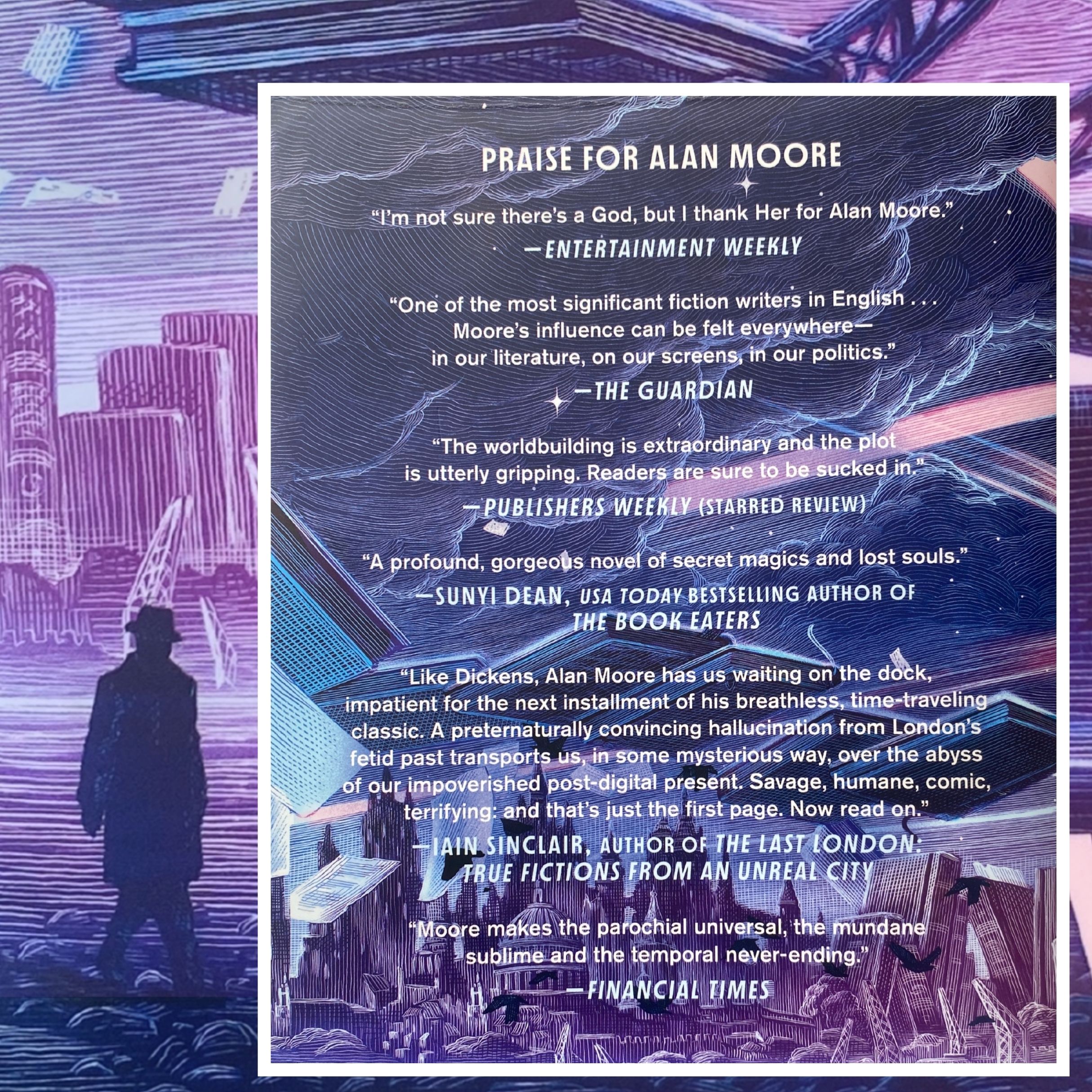
The women in The Great When stand out, if for no other reason than they offer no end of confoundment for our hero Dennis. The beautiful street walker Grace is drawn into Dennis’s misadventure, and the deliriously awful Coffin Ada, Dennis’s landlady and boss, sets the entire plot in motion, having instructed Dennis to buy the book that causes the crisis. His limerent fascination with Grace, who despite Dennis’s fantasies, is not looking to be rescued, ends on a realistic note. And the same is true for Coffin Ada, who it seems Dennis will forever be indentured to. In a neat bit of math magic at the end, Dennis finds out that Grace is much younger than he thought (15), and so is Coffin Ada (51). With this reversal of numbers, it seems Alan intimates that Grace will become something like Coffin Ada eventually, that none of them will ever escape the oppressive poverty that has overtaken a London decimated by war. Having gone through a crash course of the magical life of the other London, Dennis ends resigned to marginal survivorship and melancholy. As character arcs go, it’s kind of a downer. You’d think for a book based on magical premise that author might go for some kind of silver lining. But I suppose with a new book coming out in this series, there is the possibility that young Dennis may yet make something of himself. I will certainly be reading to find out. Pie in the sky and salt of the earth, fantastical and grimly mundane; Alan Moore really is a wizard of words, and I recommend the book to anyone who likes intelligent writing and wildly imaginative worlds.
Hazelthorn: The Garden Wants You Back
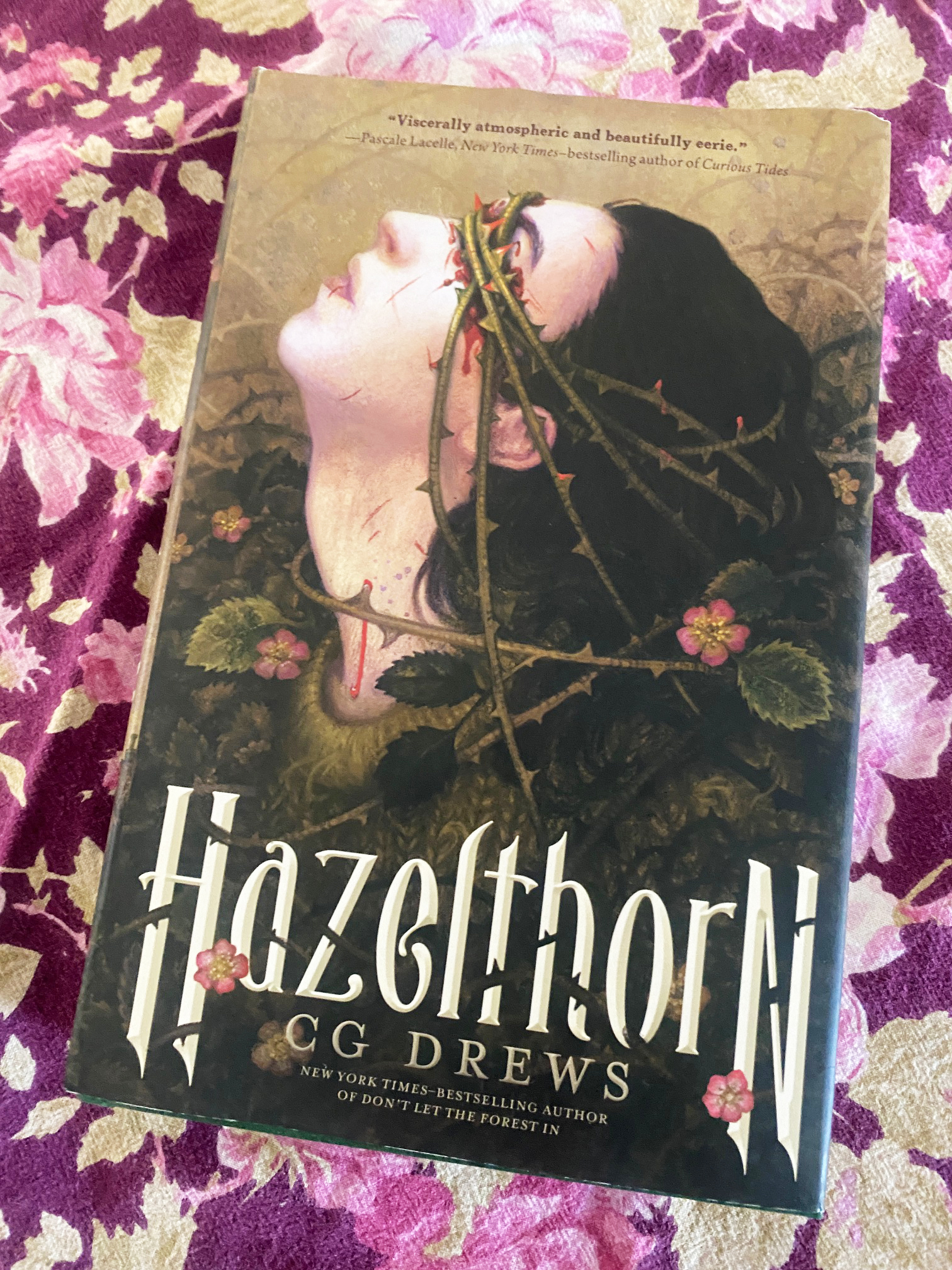
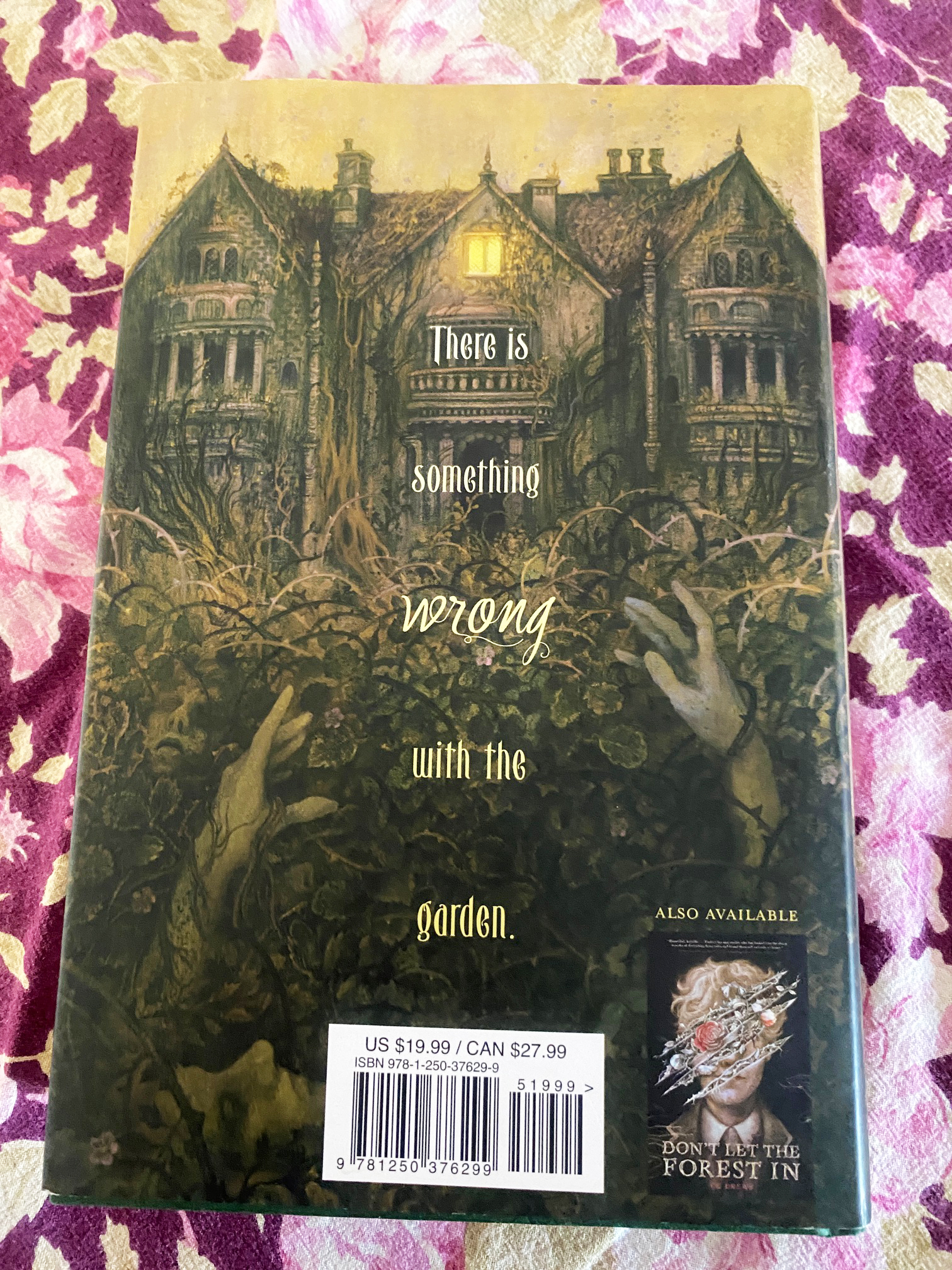
Well, you know the punchline. This book is beautifully word-smithed with amazing imagery and atmosphere that do not pander to minds that shy away from multisyllabic words and complexity. I knew from the first paragraph that I was going to fall straight in:
“He knows what it is to be buried alive, the feeling of dirt in his mouth and the quiet fitting around him like a well-tailored grave. Sometimes Evander still tastes it under his tongue, that rich earth clotting between his molars. He should have grown out of the memory by now, but he belongs to it, and not in a gentle way.”
If this is the standard of writing for YA these days, I’ll be back to that section of the bookstore with nary a flush of embarrassment.
*Plot points will be discussed now, so look away if you haven’t read the book and wish to remain innocent of the details.*
Hazelthorn is a tautly told story of Evander and Laurie, two boys in their teens, one an orphaned ward of the Lennox-Hall family and the other the grandson of Byron Lennox-Hall. The point of view is carried by Evander, who has been shut in for years, not allowed to leave his room, tended to by the butler, and occasionally having “fits” that result in unspecified medical procedures. Pale and underfed, there’s nothing much for Evander to do except read, obsess over the long-absent Laurie, and look out at the snarl of the Hazelthorn garden that seems to be trying to grow into the house, like it’s reaching for Evander.
He has been forbidden to go into the garden, forbidden to see Laurie. For his own safety, it is said. Hidden in the depths of the cavernous Hazelthorn mansion, he is completely isolated from the world, the goings-on in the house, and his forgotten past. A perfectly gothic premise for a novel, and the author CG Drews does a great job of showing us Evander’s slow and hard-gained understanding of the reality of the Hazelthorn garden, who he is, and why the Lennox-Hall family seems intent on keeping him as a sickly captive.
Laurie provides a delightful counterpoint to the clueless Evander. Laurie has just been kicked out of school and returns to the mansion, full of sarcasm and an understanding of the world that Evander does not have. Lingering between them is Evander’s memory that long ago, when they were best friends playing in the garden, Laurie tried to bury him alive. While the plot is ostensibly driven by the suspicious death of their guardian Byron Lennox-Hall and the ensuing battle for inheritance, the real plot of interest, in my opinion, is their growing understanding of one another, and the bond that keeps them intertwined. That, and the garden.
Hazelthorn’s garden is full of poisonous plants, overgrown and mysterious, a place that Evander longs to go and yet fears at the same time. The garden turns out to be the key to the Lennox-Halls’ darkest secret and Evander’s identity. It acts as a third character in the book, one that forms a triad with Laurie and Evander, and the more I read of it, the more I was Team Garden:
“The locked garden is perfectly circular, with wildly untamed underbrush running around the edges and Ever Ivy smothering the stone walls. It smells viciously of growing things, of fresh soil and vegetation rotted down, and the flowers are oddly shaped and disfigured as if they’ve been crushed and flattened out by an invisible hand. Wickedly glossy berries cluster near leaves that curve like arrow tips. Most of them he recognizes from the field guide, from the poisonous nightshade section.”
The book grips you and reads at a rollicking pace, a matter of three evenings to finish, and brings several twists that are highly satisfying. I will definitely read CG Drews’ other novels: The Boy Who Steals Houses and Don’t Let the Forest In.
So, what did I not like about the book? There are only a few things, really. The first is that the author begins with a trigger warning. To me, trigger warnings indicate a lack of trust in the reader to determine if a book is right for them. And I particularly did not like this one: “Hazelthorn is a story of queer and autistic rage and of being pushed over the edge. It is a story of the horror of being denied autonomy. It’s also about internalized shame and being at your worst before clawing your way toward self-acceptance.”
I deeply and utterly resent that the author gives away so much of what I’m about to read. It cheesed me off enough that I almost didn’t get to that amazing first paragraph. I also felt that the ending was too quickly done, perhaps 20 pages shy of the level of attention I’d have liked to see as Evander reaches a breaking point in his battle with the Lennox-Hall family. And there is a plot point involving rubies and the garden that seemed fairly ludicrous.
But on the whole, I’d give this book a 9 out of 10, and I’d recommend it whole-heartedly to people with gothic sensibilities and a love of the green world, if not a dread of the sinister nature plants can possess.
Legends & Lattes: The Virtues of “High Fantasy, Low Stakes”
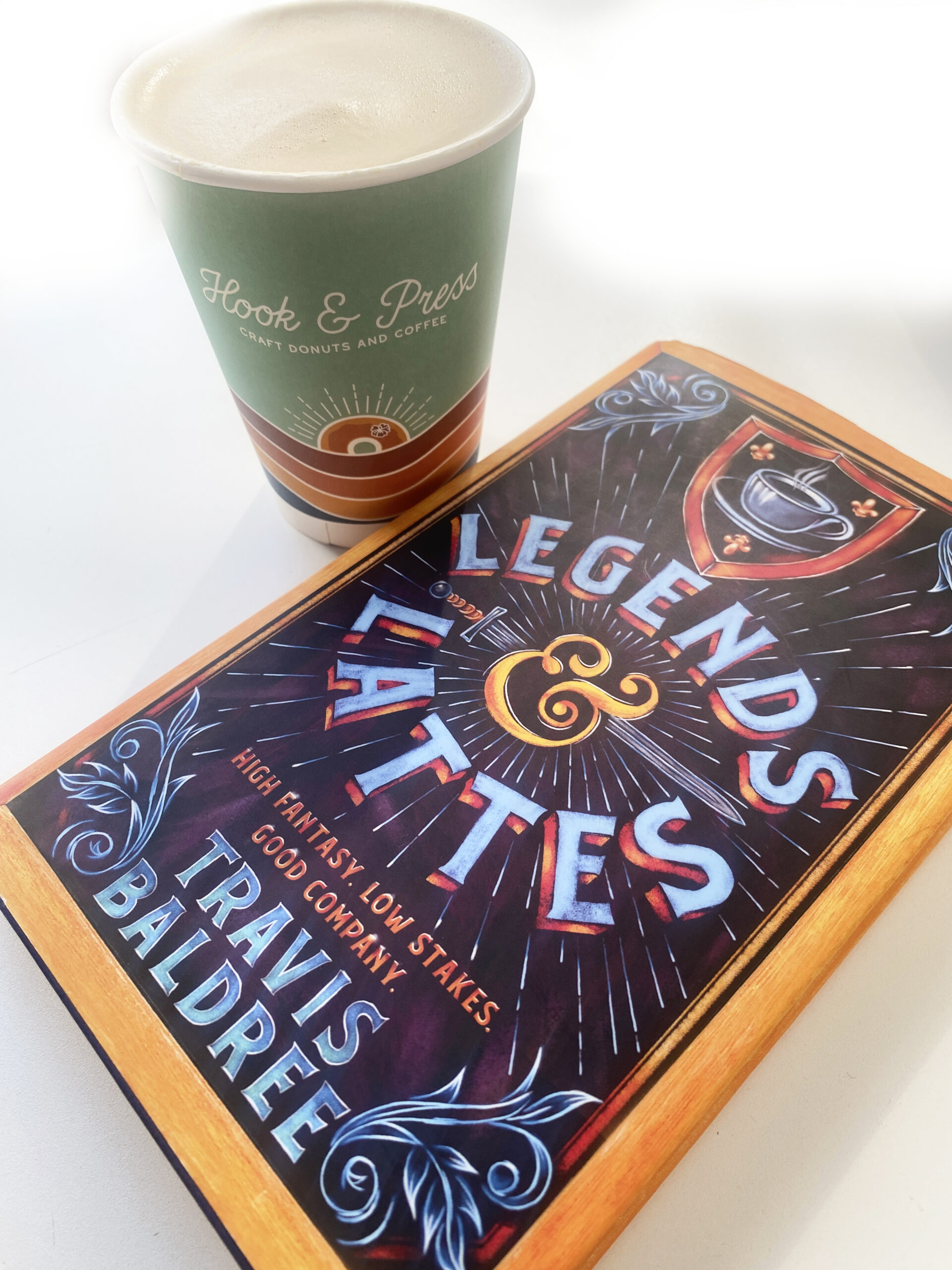
As an author, I’ve taken a lot of writing classes and been in many writing groups. I’m also an editor. And between those two functions, I’ve had it tattooed on my brain that you must have high stakes, plot tension, and a fast-moving pace. So I cast a wary eye on the Legends & Lattes byline: “High Fantasy. Low Stakes. Good Company.”
Low stakes, eh? Pretty much the opposite of what I’ve been taught fiction should be. But it turns out that “high fantasy, low stakes” is a category that includes books I’ve heard of, like Can’t Spell Treason Without Tea and The Very Secret Society of Irregular Witches, and some titles I’ve read and enjoyed, like Emily Wilde’s Encyclopaedia of Faeries.
My reading group chose Legends & Lattes because they wanted a book with a minimum of stress, a sort of escape from the upset that is so prevalent in the news these days. And I’m glad they did. Legends & Lattes is the story of an ex-mercenary orc named Vivian, who has saved up her coins to start a coffeehouse, in a town where nobody has ever heard of coffee. Viv buys an old livery building, and slowly begins meeting characters who help her build and put together the café, and those who become regular devotees of the coffee (a gnome-ish invention that Viv brings to town). The book reads quickly, but the plot points are true to life and may not seem like they’d be shimmering with antici…pation. I was expecting to be bored at scenes of Viv shopping for ceramic mugs for the café or waiting for the coffee machine to be delivered. The genius of Travis Baldree is the emotional ties he quickly creates between characters that make the reader want to know what happens next.
Tandri the succubus (who is not very succubus-y) shows up as a barista. Cal the carpenter helps build the place, and then sticks around for the coffee. A massive dire cat takes up residence as the café guardian.
And a rattkin named Thimble is soon baking cinnamon rolls that cause hobgoblins, elves, and humans alike to line up for sweet treats. I found myself absolutely entranced by the nervous, mostly silent rattkin, who worships coffee, and gets very excited about ingredients like cardamom and chocolate. I began cheering when they figured out how to make ice, so they could offer iced coffee. I smiled when I saw that Tandri the succubus and Vivian the orc were spending a lot of time together, and I was delighted at the possibility that it might bloom into something more. The regulars were just as fun to get to know: a gnome who plays chess against an invisible opponent, a lute-playing stone mason who overcomes his nerves to play for the café, a student researching ley lines who is highly suspicious of coffee. It wasn’t long before I was all in. Team Legends & Latte.
And that’s when Baldree blindsides you. There have, of course, been threats to the coffee shop, but they seem to be small ones, things that Viv can handle without bringing her sword out of retirement. But somewhere around Page 200, an act of destruction occurs that I found heartbreaking. All that Viv and her newfound family have built, which I felt part of, takes a massive blow. And this is the crux of the story. Viv can either revert to who she used to be (lethal with a sword) and seek vengeance, or she can find a way forward that stays true to the heart of the coffee shop and the friends she’s come to love.
The writing style is clean and simple. This is not a book with exquisite prose, poetic sensibilities, or words you have to look up in the dictionary. Here is an example:
“Viv started a fire, boiled water, ground some beans, and made a cup of coffee, which she drank too quickly. Then she made another. And another. As a result, she was nervier than ever and wished she’d written other instructions on the advertisement.”
Call it serviceable prose. In my opinion, it serves the story well. Given that Travis Baldree is an audiobook narrator who decided to branch out into writing during one National Novel Writing Month (the beloved, now defunct NaNoWriMo), he might not have characterized himself as a wordsmith either. But he had moxy and self-published it. In a surprise worthy of Vivian’s success at coffee-making, Baldree’s novel was an instant bestseller or Amazon, and Tor Publishing picked it up to re-publish it in 2022.
You so rarely hear about success stories like this with self-publishing that it does feel like the proverbial “warm hug” to hear of an author taking a chance and hitting the jackpot. Bookshops & Bonedust followed in 2024, and Brigands & Breadknives came out in 2025, all part of the Legends & Lattes series.
I recommend this book to any coffee-lover seeking a gentle escape into a fantastical world of whimsy and kindness.