
A Book Review by Silver Webb
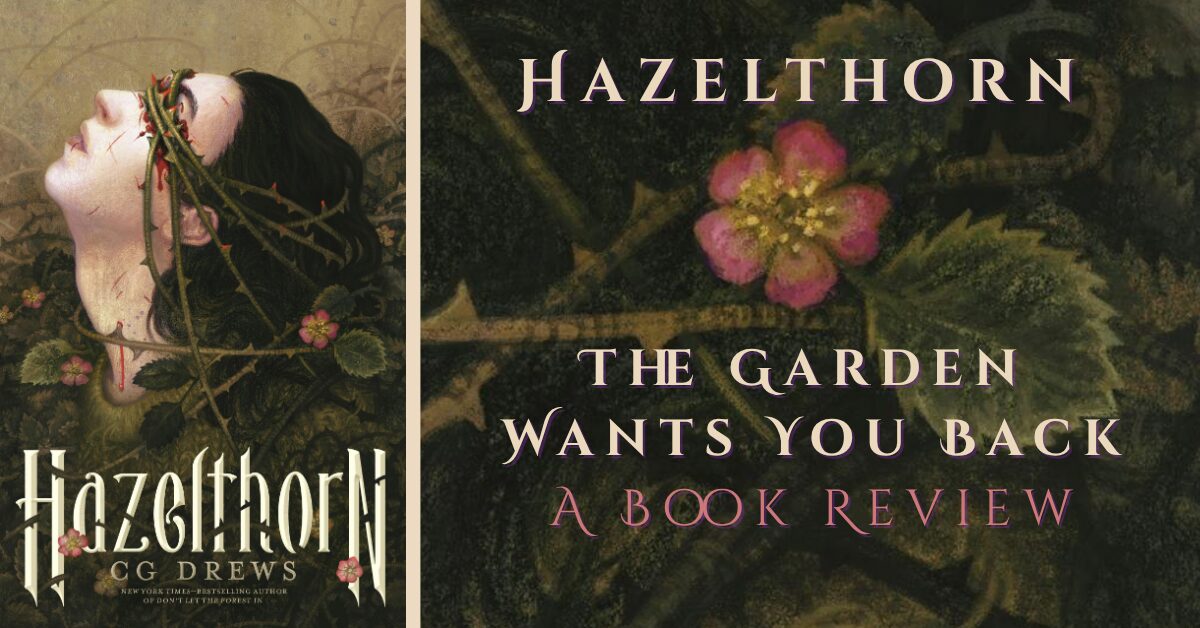
I will admit two embarrassing things here. First, I’ve been known to buy books based on the cover. Second, ever since my tenure in the young adult library section in the 1980s, I’ve generally viewed YA as a category of fiction that I’d rather have nothing to do with. My years as an editor have not disabused me of this notion. So when I set my sites on Hazelthorn, it was because…well, it was the cover that drew me in, knowing nothing as I did of the author, CG Drews. A pale youth appears to be slowly devoured by a thicket of blackberry vines. So I chirped down to the local bookstore, but couldn’t find it in the fantasy and horror section. It was with a feeling of sinking dismay that I was shuttled toward the YA section by a friendly bookstore-ista. I nabbed the book quickly and beat it out of that most embarrassing of sections.
Well, you know the punchline. This book is beautifully word-smithed with amazing imagery and atmosphere that do not pander to minds that shy away from multisyllabic words and complexity. I knew from the first paragraph that I was going to fall straight in:
“He knows what it is to be buried alive, the feeling of dirt in his mouth and the quiet fitting around him like a well-tailored grave. Sometimes Evander still tastes it under his tongue, that rich earth clotting between his molars. He should have grown out of the memory by now, but he belongs to it, and not in a gentle way.”
If this is the standard of writing for YA these days, I’ll be back to that section of the bookstore with nary a flush of embarrassment.
*Plot points will be discussed now, so look away if you haven’t read the book and wish to remain innocent of the details.*
Hazelthorn is a tautly told story of Evander and Laurie, two boys in their teens, one an orphaned ward of the Lennox-Hall family and the other the grandson of Byron Lennox-Hall. The point of view is carried by Evander, who has been shut in for years, not allowed to leave his room, tended to by the butler, and occasionally having “fits” that result in unspecified medical procedures. Pale and underfed, there’s nothing much for Evander to do except read, obsess over the long-absent Laurie, and look out at the snarl of the Hazelthorn garden that seems to be trying to grow into the house, like it’s reaching for Evander. He has been forbidden to go into the garden, forbidden to see Laurie. For his own safety, it is said. Hidden in the depths of the cavernous Hazelthorn mansion, he is completely isolated from the world, the goings-on in the house, and his forgotten past. A perfectly gothic premise for a novel, and the author CG Drews does a great job of showing us Evander’s slow and hard-gained understanding of the reality of the Hazelthorn garden, who he is, and why the Lennox-Hall family seems intent on keeping him as a sickly captive.
Laurie provides a delightful counterpoint to the clueless Evander. Laurie has just been kicked out of school and returns to the mansion, full of sarcasm and an understanding of the world that Evander does not have. Lingering between them is Evander’s memory that long ago, when they were best friends playing the garden, Laurie tried to bury him alive. While the plot is ostensibly driven by the suspicious death of their guardian Byron Lennox-Hall and the ensuing battle for inheritance, the real plot of interest, in my opinion, is their growing understanding of one another, and the bond that keeps them intertwined. That, and the garden.
Hazelthorn’s garden is full of poisonous plants, overgrown and mysterious, a place that Evander longs to go and yet fears at the same time. The garden turns out to be the key to the Lennox-Halls’ darkest secret and Evander’s identity. It acts as a third character in the book, one that forms a triad with Laurie and Evander, and the more I read of it, the more I was Team Garden”
“The locked garden is perfectly circular, with wildly untamed underbrush running around the edges and Ever Ivy smothering the stone walls. It smells viciously of growing things, of fresh soil and vegetation rotted down, and the flowers are oddly shaped and disfigured as if they’ve been crushed and flattened out by an invisible hand. Wickedly glossy berries cluster near leaves that curve like arrow tips. Most of them he recognizes from the field guide, from the poisonous nightshade section.”
The book grips you and reads at a rollicking pace, a matter of three evenings to finish, and brings several twists that are highly satisfying. If will definitely read CG Drews’ other novels: The Boy Who Steals Houses and Don’t Let the Forest In.
So, what did I not like about the book? There are only a few things, really. The first is that the author begins with a trigger warning. To me, trigger warnings indicate a lack of trust in the reader to determine if a book is right for them. And I particularly did not like this one: “Hazelthorn is a story of queer and autistic rage and of being pushed over the edge. It is a story of the horror of being denied autonomy. It’s also about internalized shame and being at your worst before clawing your way toward self-acceptance.”
I deeply and utterly resent that the author gives away so much of what I’m about to read. It cheesed me off enough that I almost didn’t get to that amazing first paragraph. I also felt that the ending was too quickly done, perhaps 20 pages shy of the level of attention I’d have liked to see as Evander reaches a breaking point in his battle with the Lennox-Hall family. And there is a plot point involving rubies and the garden that seemed fairly ludicrous and something I would’ve expected in a YA novel.
But on the whole, I’d give this book a 9 out of 10, and I’d recommend it whole-heartedly to people with gothic sensibilities and a love of the green world, if not a dread of the sinister nature plants can possess.